I've had a few friends ask me how to know if their teaching methods are "Researched Based". I found this article that maybe helpful. Good for you if you are one of the educators who wish to provide the very best for your children. With the changing tides in education and more required of teachers, it can be overwhelming to get it all organized and implement the quality education you strive for. I will continue to look for more resources.
Research/ Evidence Based Practices
Monday, May 14, 2012

Wednesday, May 9, 2012
Teacher Team Work- Cute Story I found to inspire you.
The
Story of the Geese, a lesson for all of us
flapping and honking through life to make a
difference.Lesson 1: The flapping of each
bird’s wings creates uplift for the geese that follow. By flying in a V
formation, the entire flock has a 71% greater flying range than if each bird
flew alone.
If we share in a common direction and sense of community, our going may be quicker and easier because we are traveling on one another’s thrust.
Lesson 2: Should a goose fall out of the V formation, he will suddenly feel the resistance and the drag of flying alone. If you keep watching, you will see him get back into the V formation, to take full advantage of the lifting power of the bird immediately in front.
If we have as much sense as the goose, we will keep in formation with those who share our vision, who are headed where we want to go. We will be willing to accept their help, and give our own help to others.
Lesson 3: When the lead goose gets tired, he rotates back into the formation and a new, fresh goose flies in the lead position.
As with the geese, we are interdependent upon one another.
It is helpful to take turns at the hard tasks and share the burdens of leadership.
Lesson 4: The geese aren’t honking without cause. They honk, honk, honk up to the lead goose to congratulate him for flying fast and strong.
We need to make certain that all of our honking is encouraging and never something else.
Lesson 5: If a goose gets ill or injured during flight and descends to the earth, another goose will follow. He will remain with the fallen bird until it is well again.
If we have as much heart as a goose, we will stand by each other in difficult times as well as when we are strong.
As educators, we will fly down and help our children soar to the learning sky.
To be an educator is to carry the energy of the journey of life and to find ways to help children learn to their potential.
Remember, you can do this.
You can do anything.
If we share in a common direction and sense of community, our going may be quicker and easier because we are traveling on one another’s thrust.
Lesson 2: Should a goose fall out of the V formation, he will suddenly feel the resistance and the drag of flying alone. If you keep watching, you will see him get back into the V formation, to take full advantage of the lifting power of the bird immediately in front.
If we have as much sense as the goose, we will keep in formation with those who share our vision, who are headed where we want to go. We will be willing to accept their help, and give our own help to others.
Lesson 3: When the lead goose gets tired, he rotates back into the formation and a new, fresh goose flies in the lead position.
As with the geese, we are interdependent upon one another.
It is helpful to take turns at the hard tasks and share the burdens of leadership.
Lesson 4: The geese aren’t honking without cause. They honk, honk, honk up to the lead goose to congratulate him for flying fast and strong.
We need to make certain that all of our honking is encouraging and never something else.
Lesson 5: If a goose gets ill or injured during flight and descends to the earth, another goose will follow. He will remain with the fallen bird until it is well again.
If we have as much heart as a goose, we will stand by each other in difficult times as well as when we are strong.
As educators, we will fly down and help our children soar to the learning sky.
To be an educator is to carry the energy of the journey of life and to find ways to help children learn to their potential.
Remember, you can do this.
You can do anything.
http://www.ganderpublishing.com/About-Gander-Publishing.html
Helpful RtI Websites
Fellow Teachers, I have come across some websites that can be helpful and informative for you and your staff when working towards fine tuning your RtI aproaches.
http://www.rti4success.org/
http://www.florida-rti.org/
http://www.rti4success.org/
http://www.florida-rti.org/
Marshmallow Math
In March and April we used marshmallows to help learn about angles, vertices and sides. We also use the marshmallows along with toothpicks and fruit loop cereal to discover and practice the 100's, 10"s and 1's column. It was a lot of fun.


Angles, shapes and vertices
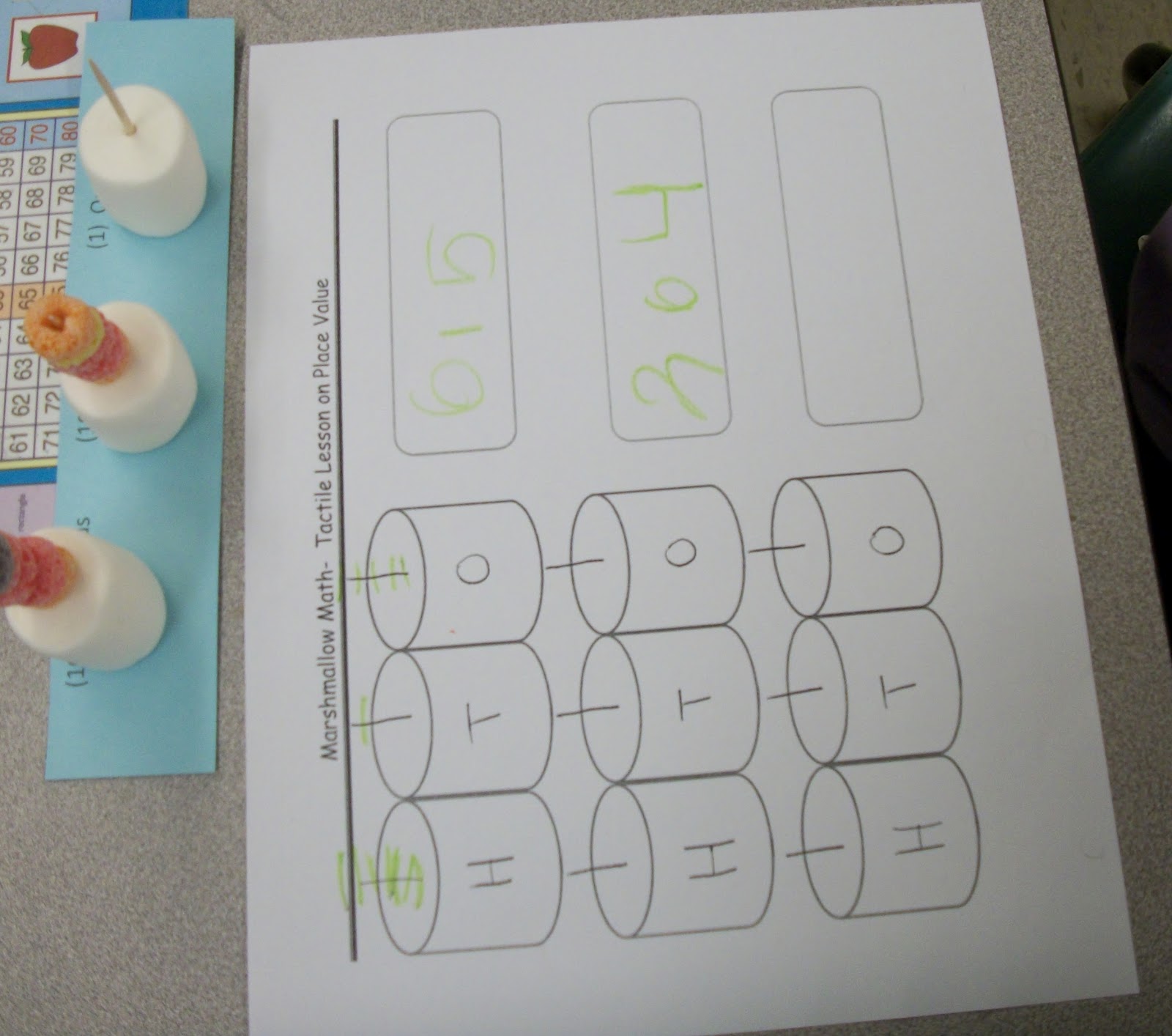
100's, 10's, 1's place value and writing
numbers in expanded form
Sunday, March 18, 2012
Autism Awareness is in April
As some of you know I have a special place in my heart for Autism. April is a month that the wonders and curiosity of Autsim is talked about more in the media. Here a link to learn more or to donate for research. http://www.autism-society.org/about-us/national-autism-awareness-month/
Butterflies and Chickens! Which came first, the egg?
This is the time of year when our classroom has an influx of wildlife. Every year we watch the butterfly cycle from caterpillar to adult butterfly. We've already read many stories about this so the children will be excited to see it come to life inside our butterfly cage. I ordered the caterpillars online and they should be at school soon.
Chicks, chicks and more chicks. We will also start our Egg to Chicken experiment. A local mom and grandma donate eggs and the incubator for our kiddos to start the 21 day journey.
These two activities are a great way to discuss our Earth and Conservation. I love this time of year.
Butterflies were ordered from www.insectlore.com .
Chicks, chicks and more chicks. We will also start our Egg to Chicken experiment. A local mom and grandma donate eggs and the incubator for our kiddos to start the 21 day journey.
These two activities are a great way to discuss our Earth and Conservation. I love this time of year.
Butterflies were ordered from www.insectlore.com .
Sunday, March 11, 2012
Who Took the Cookie From the Cookie Jar?
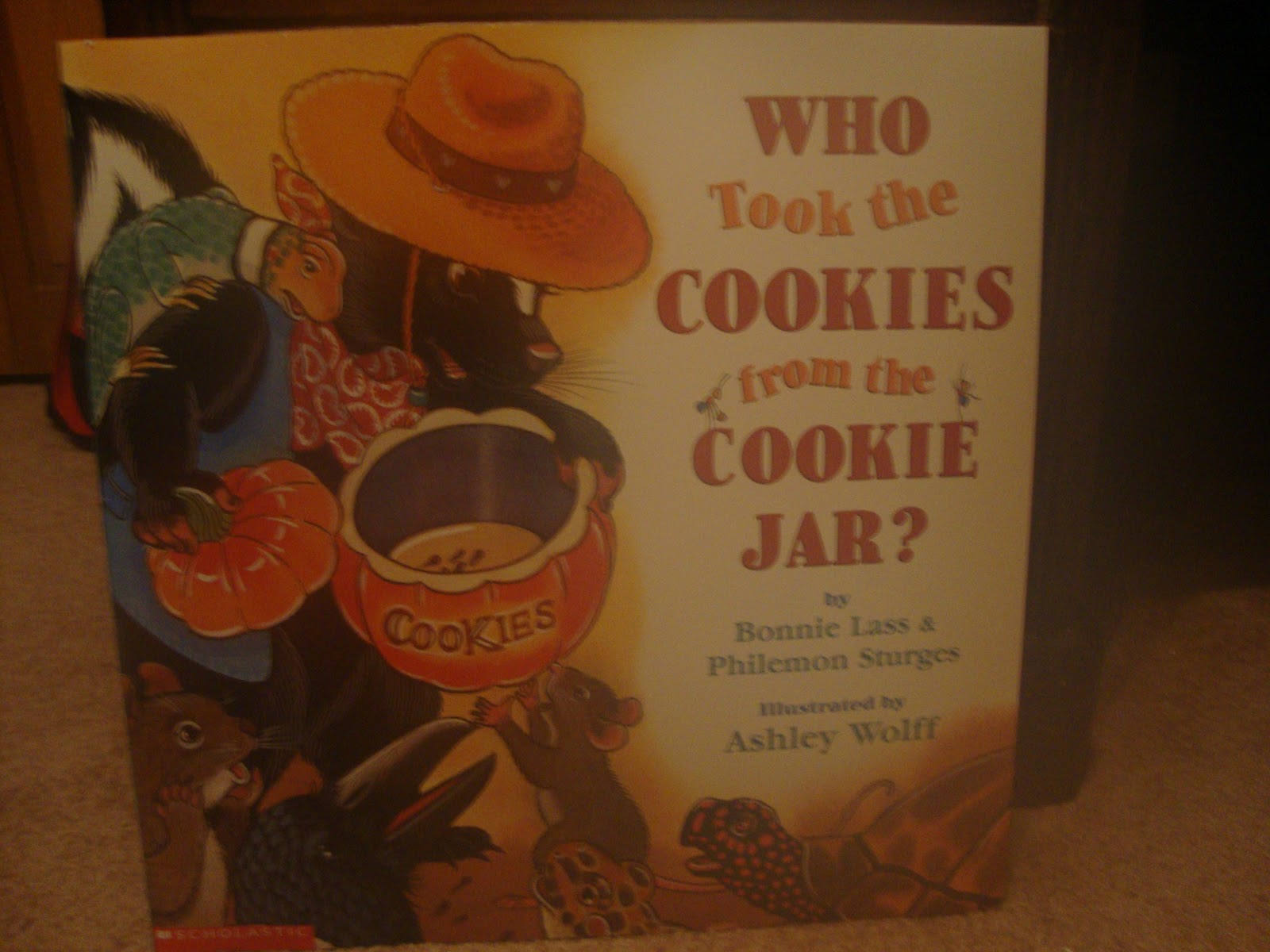

We will use the poem to discuss sentence conventions and structure. The rhythmic pattern of the poem is perfect for emergent readers. We know that memorization is a building block to fluent readers some day.
I have a large cookie model I made from canvas. We will use this for our vocabulary words and math activities this week. Educational researchers tell us that children's brains best remember and learn when we give them a visual way to compartmentalize the information. Simply by displaying and interacting with manipulatives on the cookie will help them to make the needed connections of the concepts we teach.
Monday: I will start the lesson by placing pictures of all the characters from the story in front of the children; a raccoon, snake, beaver, frog and ants. Next I will show them the front cover of the book and read the title. Then each child will get to make a prediction using tally marks (math integration) of the animal they think took the cookies. We will "picture walk" the story and then read the story. This lesson will be a spring board for the week's lessons of sequencing and comprehension as well as sight word and rhyme word reading. I'm looking forward to it. At the end of the week we will make some cookies...healthy..gluten free, whole wheat..of course! :) .
Subscribe to:
Posts (Atom)